Newport News, VA · Garage Door Service
Garage door repair for Smithfield, VA, done by a Newport News crew that knows the newer 1990s-era stock here differs from older parts of the service area.
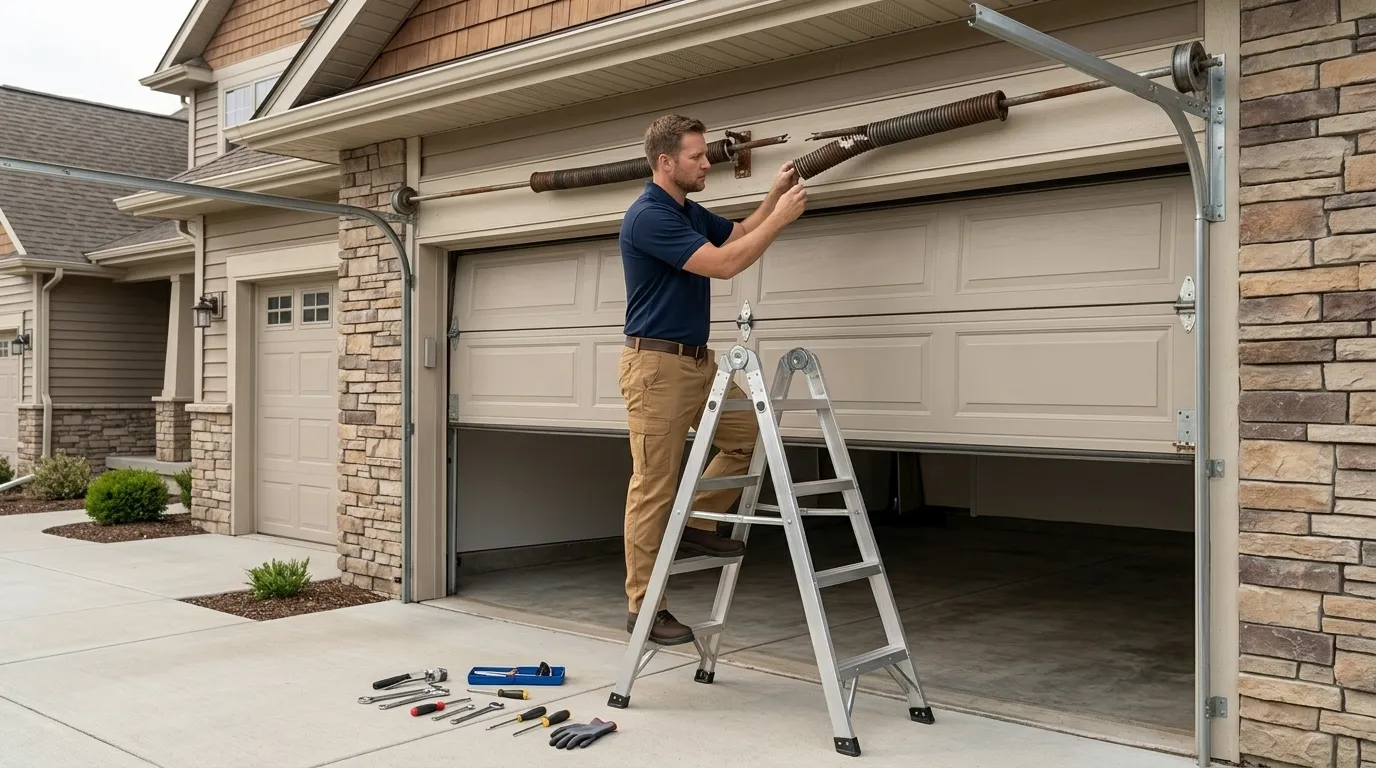
Smithfield is a small place - about 3,453 households, not the sprawl you get closer to Newport News. That size matters for the kind of jobs that come up. There's no dense cluster of identical builder-grade doors going bad on the same week the way you see in bigger tracts. Calls here tend to be spread out, one house at a time, often a door that's been running fine for years and then isn't.
The housing stock plays into this too. Across the wider service area, homes were built anywhere from 1948 to 1992, with a lot of that older stock still running original one-piece doors and side-mount torsion hardware. Smithfield sits at the newer edge of that range, with a median build year around 1992. That means extension-spring setups and steel sectional doors are more common here than the older wood-panel doors we see closer in. The failures are different - less rot and warped panels, more worn rollers and fatigued spring coils on doors that have simply logged twenty-plus years of cycles.
We drive out from Newport News, about 9 miles, so we're not sitting in Smithfield waiting on a call. Same-day isn't something we promise here - it depends on the truck's route that day.
Some of it, yes. Tightening loose hinge bolts, cleaning and lubricating tracks, replacing worn weatherstripping along the bottom of the door - all reasonable weekend jobs, and none of them need a truck out from Newport News.
What you shouldn't touch is anything involving the torsion or extension springs, or the cables that run under tension when the door is down. Those parts store enough force to break a hand or worse, and there's no safe way to learn on the job. If a spring has snapped, or a cable has frayed and jumped its drum, that's not a DIY afternoon - that's a call.
Openers are a middle case. Swapping a remote battery or reprogramming a keypad is fine. Replacing the opener's logic board or motor, especially on a door with an older chain-drive unit, is where a lot of homeowners get in over their heads and end up with a door that won't reverse properly - a real safety problem if kids or pets are around.
Most Smithfield calls start the same way: a walk-through of the whole door system, not just the part that's obviously broken. A dead spring or a stuck opener is often the visible symptom of something else - a bent track, a misaligned sensor, rollers that have been grinding for months.
On a door here from the early-to-mid 1990s build era, we're usually looking at extension springs mounted along the horizontal tracks rather than a torsion bar over the header. That changes what gets replaced and how the door gets balanced afterward. Balance testing matters - a door that closes hard or won't hold halfway is almost always a spring tension problem, and getting that right takes weighing the door against the spring's pull, not guessing.
Any repair on the cable or spring system ends with a full cycle test: open, close, reverse-on-contact, and a check that the door holds position when disconnected from the opener. If it doesn't hold on its own, the springs aren't doing their job, no matter how the opener performs.
We carry common rollers, cables, hinges, and standard extension and torsion springs sized for the door widths that show up most in this part of the service area. Those cover the majority of Smithfield calls without a special order.
Where it gets slower is anything discontinued or sized for an odd door width - some builder-installed doors from the 1990s used non-standard spring wire gauges that aren't stocked on the truck and have to be ordered in. If that's the case, we'll tell you up front rather than swap in a part that's close enough but not right, which just fails again sooner.
Opener boards for older chain-drive units are the other common wait. If your opener is original to a house built around 1992, the exact replacement board may not exist anymore, and the honest fix is a new opener rather than chasing a part for a discontinued model.
The call we get most from this part of the service area is a door that's suddenly heavy - it used to lift with one hand or barely any pull on the opener, and now it drags, groans, or won't move past halfway. That's almost always a spring that's lost tension or snapped outright, not a motor problem, even though the opener usually gets blamed first.
A close second is a door that reverses partway down, or won't close at all and just bounces back up. That's the opener's safety sensors doing their job - usually because something's blocking the sensor path, the sensors have drifted out of alignment, or a cable has slipped its drum and thrown the door off level.
Both of these are worth a look before they get worse. A door running on a fatigued spring can snap a cable next, and a door that won't reverse properly is a real hazard if something or someone is under it when it comes down.
No. We're based in Newport News and drive out to Smithfield, about 9 miles, for every call. We don't stage a truck or keep a local office here, so there's no local same-day guarantee - it depends on where the truck is routed that day.
Smithfield's housing runs newer than a lot of the rest of the service area, with a median build year around 1992. Homes from that era typically got extension springs mounted on the horizontal tracks, while older 1950s and '60s houses elsewhere more often used torsion springs over the header. Different setup, different failure pattern.
We don't quote a number without seeing the door - spring size, door weight, and whether it's a single or double door all change the price. What we can say is the trip charge covers the 9-mile drive from Newport News, and we'll give you a firm number before any work starts.
Could be either, which is why it's worth a proper look rather than a guess. A door that reverses or stalls partway is often a misaligned safety sensor or a cable that's jumped its drum, not the motor itself. We check the whole system - track, cable, springs, sensors - before pointing at any one part.
Call now or request a free quote - same-day service on most repairs, upfront written pricing.
