Newport News, VA · Garage Door Service
Broken torsion springs on 1960s-70s Newport News homes need same-size, same-cycle replacement. Here's what the repair involves and why it happens here.
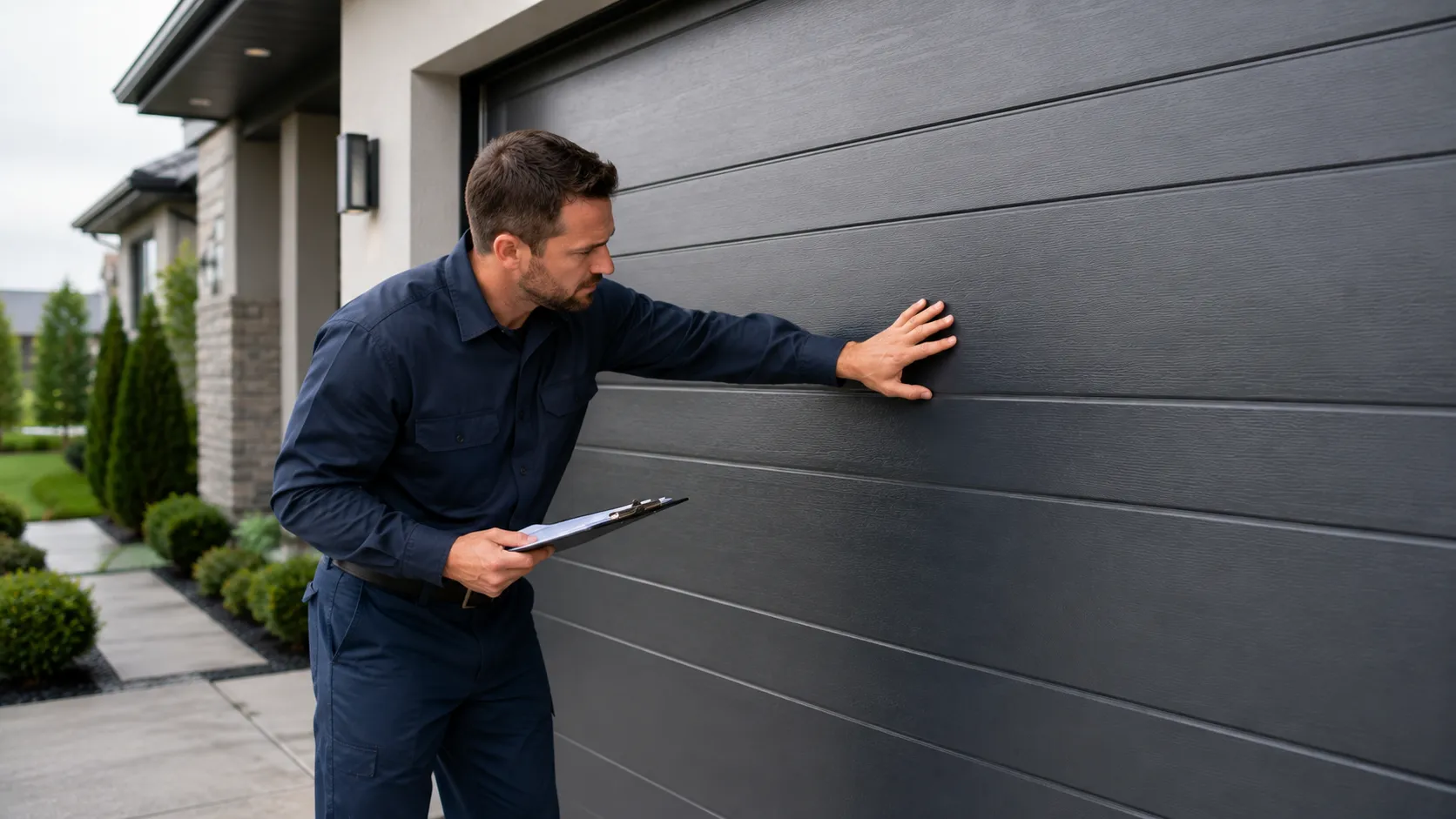
A spring repair is a swap, not a patch. Torsion springs wind and unwind thousands of times before they fatigue and snap, usually at a coil near the winding cone. We measure the wire gauge, inside diameter, and length off the broken spring (or off the door's weight and track drums if the spring is gone in pieces), then wind in a matched pair sized for that door's weight, not just its width. On a lot of houses in this service area that still carry their original two-spring setup from the 1960s-70s building wave, that means matching hardware that isn't on a shelf at the big box store - it has to be wound to spec.
We also check the drums, cables, and center bearing while the tension is off the shaft, because a spring rarely fails alone. If a cable is frayed or a drum is cracked, replacing the spring and leaving those parts is a callback waiting to happen. On aluminum or lighter steel doors from the same era, we'll also check the top panel for stress cracks near the strut, since an old spring that's been overpowering a sagging door can mask a second problem.
One limit worth saying plainly: if the door itself has warped panels or rusted-through track, spring repair alone won't fix the door's overall behavior, and we'll tell you that instead of just billing a spring swap.
The classic sign is a door that won't stay up, or drops fast on the way down like something let go. Sometimes it's a loud bang from the garage - that's the spring itself failing, not an opener issue. Other times it's slower: the opener strains, chain or belt sounds like it's working too hard, or the door feels heavier by hand than it used to. If you disconnect the opener and lift the door manually and it feels like dead weight instead of near-balanced, that's a spring problem, not a motor problem.
A torsion spring that's cracked but not fully broken can still hold the door partway, which is why some owners drive on it for a week or two before it lets go completely. That's the point where a second spring on a two-spring setup is also close to its own fatigue limit, since both were wound and cycled the same number of times since the house was built. We don't recommend waiting on a visibly cracked spring - the failure point is usually the cable or the person standing under the door when it goes, not the spring itself.
Once we're on site with the right spring size, a torsion spring replacement on a standard double door is a same-visit job - the door goes back into normal use within a couple of hours of us arriving, including the safety checks after. What extends the timeline isn't the labor, it's sourcing. Newport News's housing stock skews to 1948-1992 construction with a concentration in the 1960s and 70s (median year 1977), and a fair number of those garages still have older hardware - non-standard drum sizes, older-style end bearing plates, or spring lengths that don't match current stock sizes. When that's the case, we may need a day to get the right wind in, rather than the common size we keep on the truck.
We won't put a close-enough spring on your door to save you a day, because a mismatched spring either overpowers the opener or leaves the door heavy on one side, and that shows up again within months as uneven wear on the tracks and rollers. If we don't have your exact spec on hand, we'll say so up front and give you a real number, not a guess.
Springs fail on a cycle count, and cycle count is a function of age plus climate. Newport News sits in a cold-moderate band, which means garage doors here go through more temperature swing across a year than in a warmer climate, and steel behaves differently at each end of that swing - the metal contracts in cold weather, which increases tension on a spring that's already near the end of its wind life. That's a bigger factor here than in a market that stays warm year-round.
Layer that onto the age of the stock: with most homes built between 1948 and 1992 and a heavy concentration in the 1960s and 70s, a large share of garages in this service area are carrying original or first-replacement springs that are now 45 to 65 years into a part rated for roughly 10,000 cycles. Two winding cones, one door, and decades of temperature swings is exactly the setup that produces a snap on a cold morning rather than a slow leak of performance. Newer builds in the area don't show this pattern nearly as often - it's specifically the older side of the housing stock that calls us.
It depends on the spring size, whether it's a one- or two-spring setup, and whether drums or cables need replacing at the same time. We don't post a flat number because older houses in this area often need a non-standard spring, which changes the price. We'll give you a firm number after we see the door.
You can, but we don't recommend it. Both springs on a double door cycle the same number of times, so if one has failed from fatigue, the other is close behind it. Replacing both at once means one visit instead of two.
Only with the opener disconnected and real caution - a door with a broken spring is unbalanced and can drop without warning. We'd rather you leave the car outside for a day than lift a door that's fighting you.
If it's failing faster than the last one, the size or wind may not have been matched correctly, or something else - a bent track, a stiff roller - is putting extra load on it. We check the whole system, not just the spring, when this happens twice.
By Neighborhood
We also handle spring repair in these Newport News-area suburbs.
Call now or request a free quote - same-day service on most repairs, upfront written pricing.
