Newport News, VA · Garage Door Service
Yorktown's houses date mostly to 1967, when extension-spring cable systems were standard. We travel 11 miles from Newport News to fix frayed or snapped cables here.
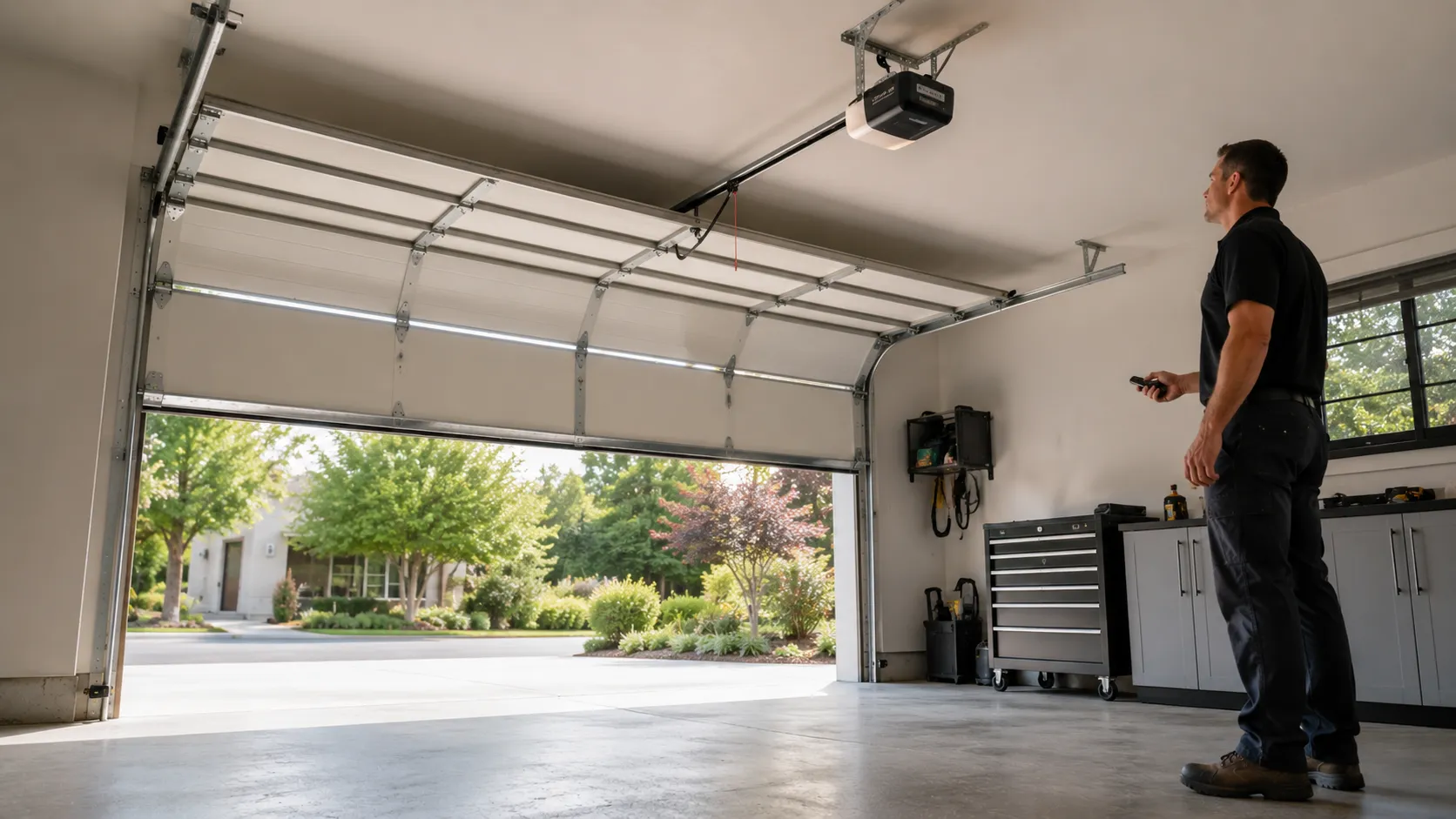
A garage door cable under tension is not a weekend project, and on a house from the Yorktown building wave that's centered around 1967, the risk is higher than on newer stock. Those doors typically ran extension springs, not torsion, with cables looping over pulleys at the bottom corners. If one side lets go while the door's up, the whole panel can drop unevenly and come off track, sometimes taking the pulley bracket with it. We're not going to tell you it's impossible to do safely, but we will tell you the spring is holding real force, the cable is thin gauge steel that can whip if it snaps, and the tools for re-securing a drum or pulley on a door this old aren't something most homeowners have sitting in a drawer. If the cable's already frayed but hasn't broken, leave the door down and call rather than run it through more cycles. If it's already snapped, don't try to force the door up by hand - wait for the visit.
On the 1967-vintage doors common in this part of Yorktown, the tell is usually a door that drops crooked - one side rides down normally while the other side lags or falls fast, because one cable has given out and the other is doing all the work. Sometimes you'll hear a snap first, sometimes just a scraping sound as the frayed strands catch on the pulley before it lets go entirely. On these older extension-spring setups, the cable runs exposed along the track rather than wound on a drum near the header, so corrosion and fraying tend to show up lower down where you can actually see it if you look. If the door came down hard and now sits tilted in the opening, or one bottom corner is lower than the other, that's the cable, not the opener.
We run this job out of Newport News, and Yorktown sits about 11 miles out, so a cable repair here is a scheduled trip rather than a same-hour drop-in. Once we're on site, swapping a snapped cable on a standard extension-spring door is usually a same-visit fix - it's not a job that needs to come back a second time unless something else on the door turns out to be worn past matching, which on hardware pushing toward sixty years old is worth checking while we're there. The honest limitation: if the pulley bracket or the track itself is rusted through rather than just the cable, that's a different repair, and we'll tell you before we start rather than after.
Across the wider service area - 52,867 households and 24,011 owner-occupied houses - the doors going up between 1948 and 1992 lean heavily on 1960s and '70s hardware, and the pocket of Yorktown we cover fits that pattern closely with a median build year of 1967. We keep standard-gauge extension-spring cable and matching pulleys on the truck because that's what most doors from this era actually need, not because it's exotic. Where it gets slower is when a door has already had a mismatched cable swapped in by a previous repair, or when the drum or pulley itself is the odd part out - a non-standard bracket from a door that's been patched more than once. On those, we may need to source the exact match rather than pull it straight off the truck, and we'll say so up front rather than guess.
The climate here runs cold-moderate, which means these cables go through real freeze-thaw cycling every winter - not extreme cold, but enough seasonal moisture and temperature swing over fifty-plus years to work rust into strands that look fine from a few feet away. On a 1967-era door, that's the most common complication: the cable itself is fine at first glance, but the last few inches near the pulley are frayed under the coating. Rust bleeding onto the track or bottom bracket is another sign the whole assembly has been sitting exposed longer than the cable's rated for. Neither of those is a quick swap - both mean we're replacing hardware beyond just the cable, and that adds time to the visit.
We don't have a set number for this specific job to quote you here, and we're not going to invent one. What we can tell you is that a straight cable swap on a standard extension-spring door - the kind common to Yorktown's 1967-median housing - is one of the more contained repairs we do, versus a job that turns up a rusted drum or a mismatched pulley from an earlier repair. Across the broader service area median household income sits at $82,589, which tracks with the kind of owner-occupied housing stock we're working on here, but that number doesn't set your price - the actual state of your cable, pulley, and track does. We'll give you a real number after we look at the door, not before.
On doors from the 1960s-70s wave common in Yorktown, the cable runs exposed over a pulley rather than sealed in a drum housing. Years of freeze-thaw moisture in this climate work rust into the strands gradually, so you often get fraying and partial failure before a full snap - which is actually the better warning sign to catch early.
No. We run out of Newport News and travel the roughly 11 miles to Yorktown for cable repairs. That means we schedule the visit rather than offer an instant same-hour arrival, but the repair itself is typically finished in one trip.
Most houses in this part of Yorktown were built around 1967, and doors from that era mostly used standard-gauge extension-spring cable, which we carry on the truck. If a prior repair swapped in a non-standard part, sourcing an exact match can add time - we'll know once we've looked at the hardware.
Call now or request a free quote - same-day service on most repairs, upfront written pricing.
