Newport News, VA · Garage Door Service
Roller replacement for Yorktown, VA homes built around 1967, 11 miles from our Newport News shop. Steel or nylon rollers, priced by the job, not a flat rate.
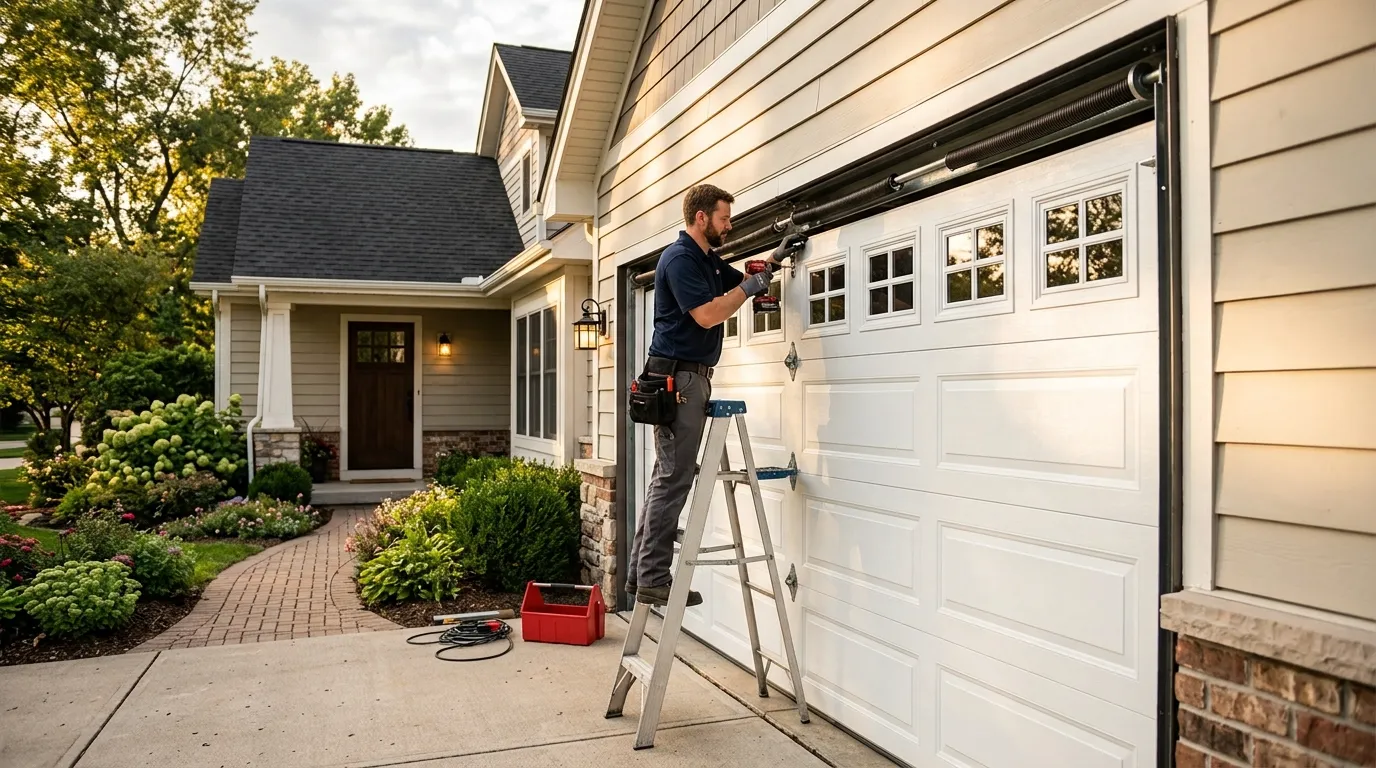
Swapping a single worn roller on a door that still opens fine is a job a lot of homeowners handle themselves - pull the retaining pin, slide the old roller stem out of the hinge, seat the new one, done. Where it stops being a weekend job is a house like the ones common here, built around 1967, where the whole set has been on the track for decades and the roller stems have worn the hinge holes oval. Pull one roller on that setup and the panel above it can drop or bind, and now you're fighting a track that's out of alignment on top of the roller swap. If the door is heavy - most double doors are - and the springs are original too, that's not a one-person ladder job anymore. We're honest that a full-set roller replacement on an older door usually needs two people and the right pin punch, not a pair of pliers from the junk drawer. If you're comfortable with hand tools and the door only needs one or two rollers, go for it. If it's the whole set and the track shows rust or bowing, that's a call, not a project.
The tell on a Yorktown-area door of this vintage is a grinding or clicking sound as the door travels, worse at the top and bottom of the run where the curve in the track puts the most side load on the roller. Steel rollers from the 1960s and 70s didn't run on bearings the way nylon ones do now, so by year forty-plus they're often worn into a slight oval instead of a true circle - you'll feel it as a shudder rather than a smooth glide. Owners sometimes describe it as the door "walking" sideways in the track, which is really the flat spot on the roller catching the rail every rotation. Cold-moderate winters here don't cause that wear on their own, but they do stiffen old grease and make an already-tired roller squeal louder in January than it did in July. If the noise is a rhythmic thump matched to the door's travel speed, that's rollers. If it's a single loud bang followed by the door refusing to move, that's a spring, and that's a different call entirely.
A roller replacement on its own doesn't usually take the door out of service for long once a truck is on site - it's a same-visit repair, not a multi-day teardown. The variable here is scheduling the trip out, not the work itself: we run this out of Newport News, and Yorktown sits about 11 miles from the shop, so it's not a same-hour walk-up the way a call closer to base can be. Most of the delay owners experience is the gap between calling and getting a truck out, not the roller swap itself. Once the tech is there, a full roller set on a double door is typically finished well within a single visit, track cleaned and realigned as part of the job since worn rollers usually mean the track has taken some abuse too. We won't quote a specific arrival window here since that depends on the day's route, but the repair portion is quick once parts are in hand.
Nylon rollers with sealed bearings are the standard replacement now and what we carry as the default swap for steel-roller doors - quieter, and they don't wear oval the way the originals did. For a house built around 1967, the roller stem length and hinge spacing usually match common older hardware patterns, which is stock we carry rather than something we'd need to special-order. Where it gets slower is if the door itself is a less common panel design or the track has been replaced at some point with a mismatched size - that's the case where a part has to be ordered rather than pulled off the truck. We're not going to pretend every door in an area with housing stretching from 1948 to 1992 uses identical hardware; it doesn't. But the roller itself, as opposed to a full track or hinge set, is about as standard a part as this trade has, and that's true whether the door is from Yorktown or anywhere else in the service area with the same era of stock.
The complication that shows up most on older doors isn't the roller, it's what the roller has been hiding. When steel rollers wear down over decades, the hinges and track absorb extra side-load, and by the time someone calls about noise, the hinge holes are often stretched and the track has a slight bow from years of that off-center pressure. Swap the roller alone on a track like that and it'll ride rough again within a season. That's the honest limitation on this job: a roller replacement that looks simple on the phone sometimes turns into a hinge or track repair once a tech is under the door, especially on a house that's been running the original hardware since 1967. We won't upsell a job that doesn't need it, but we also won't hand back a door where the fix won't hold. The other complication is springs - on a door this old, if the springs haven't been replaced, they're closer to end of life than the rollers are, and it's worth having both checked at once rather than paying for two separate truck trips.
The service area's median household income sits at $82,589, and at that level a roller replacement is routine maintenance money, not a decision that competes with replacing the whole door. That math changes the calculation for houses like the ones common in Yorktown, built around 1967 - old enough that the rollers are original and tired, but not so far gone that the door itself needs replacing. Where the cost climbs is if the track or hinges need attention alongside the rollers, since that's added labor and parts beyond the roller set itself. We price this job by what's actually worn, not a flat number quoted before anyone's looked at the door, because a single-roller fix and a full eight-roller set with track realignment aren't the same job or the same bill. For a household at or near that area median income, a roller job is a small maintenance expense; it only turns into a bigger decision if it's paired with springs or a track that's bowed past straightening.
Cold-moderate winters stiffen old grease and make wear that's already there more noticeable - a roller worn slightly oval from decades of use will squeal or clunk louder once the lubricant thickens up in cold weather. The cold doesn't cause the wear, it just makes an existing problem harder to ignore.
Nylon rollers with sealed bearings are quieter and don't wear oval the way the original steel rollers on 1960s and 70s doors do. We stock nylon as the standard replacement for that reason, and it's a direct swap on the hinge spacing most doors from that era use.
We run this job out of Newport News, and Yorktown is about 11 miles from the shop. We don't quote a fixed arrival window on this page since that depends on the day's route, but once a tech is on site, a roller swap is typically a same-visit repair.
Usually, yes - but on an older door, worn rollers sometimes mean the hinges or track have taken damage too. If that's the case, we'll tell you before doing extra work you don't need, and a roller-only fix on a bowed track won't hold long.
Call now or request a free quote - same-day service on most repairs, upfront written pricing.
